"Achieving independence with every step..."

2026 Summer Camp
Registration Open Now!
To sign up please fill out the registration form down below.


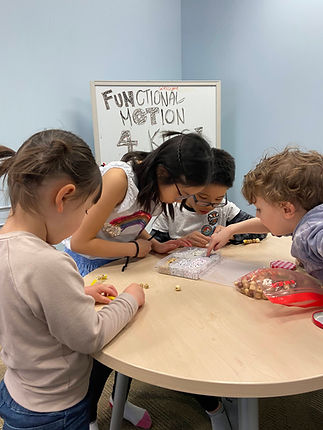
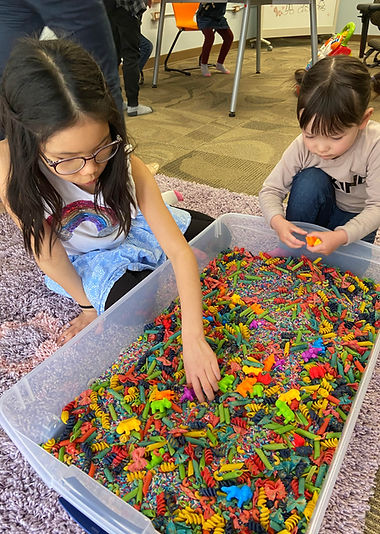
Summer is an ideal time for children to practice interacting with peers in a fun, supportive environment—helping them build confidence with communication, friendships, and emotional regulation. Social development includes practicing turn-taking, learning to cope with winning and losing, developing perspective-taking, and exploring emotions through role-playing and guided interaction.
Did you know that integrating the eight sensory systems through therapeutic movement can support brain function and positively impact mood?
Our approach is grounded in the understanding that motor and sensory development are closely linked to cognitive and emotional regulation. The cerebellum—an area of the brain responsible for movement—contains the highest number of neurons and plays a key role in coordination, attention, and regulation.
By targeting these foundational systems through movement and sensory-based activities, we are also indirectly supporting cognitive development such as improved attention, communication, and emotional regulation. A camp environment allows for increased intensity, repetition, and peer-based practice, supporting the generalization of these skills into functional social contexts.
2026 CAMP SCHEDULE
July 13-17 Monday To Friday Daily
-
9:00 am to 12:00 pm
-
Deadline to register: July 8, 2026
July 20-24 Monday to Friday Daily
-
1:00 pm to 4:00 pm
-
Deadline to register: July 15, 2026
August 17-21 Monday to Friday Daily
-
9:00 am to 12:00 pm
-
Deadline to register: August 12, 2026
*****Cost: $425 (official receipt will be provided for medical reimbursement)
Camps will run with a minimum of 6 children.
Spots are limited—registration is on a first-come, first-served basis to ensure a small, supportive group experience.
Get to Know Me
Background Information
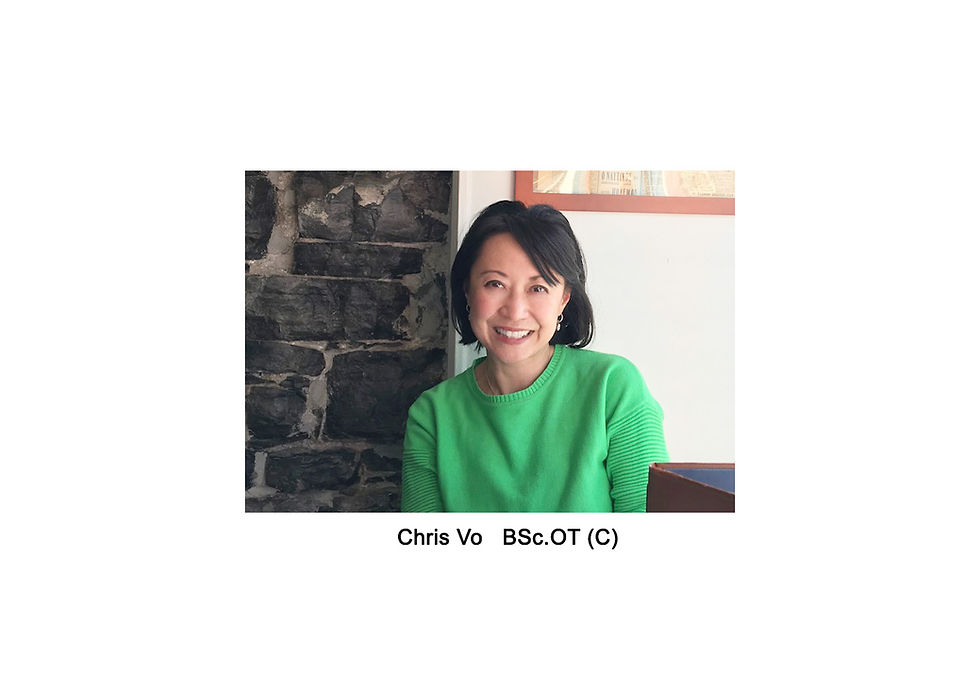
My name is Chris Vo, a registered Occupational Therapist with over two decades of experience. I graduated from the Bachelor of Science in Occupational Therapy program at the University of Alberta in 1996.
My clinical experience includes brain injury, orthopedics, and pediatrics across both public (Glenrose Rehabilitation Hospital, Northern Gateway Public School Division) and private sectors.
I specialize in working with children with sensory processing challenges, developmental delays, and Autism Spectrum Disorder. I offer 1:1 therapy, virtual consultation, and school-based support.
I offer 1:1 therapy, virtual consultations, and school-based support to teachers and educational assistants (EA). During the summer, I also run small group camps focused on building social skills.
My practice and treatment philosophy is simple; integrate skills into function. A single skill acquired without purpose is meaningless.
My goal is to ensure that the child is able to combine individual skills acquired into meaningful movements allowing them to be successful in areas of self care (life skills), productivity (school goals) and leisure (meaningful play).
I am looking forward to hearing your child's story!

Skills Development
"A child is like a butterfly in the wind. Some can fly higher than others, but each one flies the best it can. Why compare one against the other? Each one is different, each one is special, each one is beautiful".....Bethany Hamilton

FINE MOTOR SKILLS
Fine motor skills is defined as deliberate, controlled movements involving the fingers and hand.
The development of fine motor skills is crucial to a child's ability to experience and learn about the world.
It's an essential part of growth and development in a child.
Fine motor (FM) skills develop in an orderly progression. Through informal observation and/ or formal assessment, skills that require additional support will be identified and treatment plans established.
Tactile, vestibular and proprioceptive processing, bilateral coordination, body awareness, directionality, midline crossing, motor planning, spatial awareness, acuity binocularity and visual tracking need to work together in order to achieve FM success.
Strengthened FM skills will help support success in school and help the child achieve greater independence with self care (feeding, dressing).

GROSS MOTOR SKILLS
Gross motor development refers to physical skills that entail large body movements most often involving the entire body.
Good motor skills allows a child to better explore their environment which invariably leads to improved cognitive development.
Successful, functional movements require a subset of numerous skills that need to be addressed or explored to determine WHY a specific movement requires additional support.
Functional movements are being taught through meaningful play in addition to strengthening the muscles of the body to ensure that it is properly supported.
Proper body mechanics and good posture are essential to prevent future injuries when engaging in physical activity.

LIFE SKILLS
Maximizing independence in the areas of self care (dressing, feeding and personal hygiene), and social skills (socialization training, safety and self management).
Achieving success in any of the above areas require understanding the root of the problem. A detailed task analysis of a specific life skill will identify whether the delay is a sensory, proprioceptive or motor issue. Once these components are properly identified we can then choose the appropriate treatment strategy.
There is no cookie cutter formula as each child is unique in their challenges and learning.

SENSORY INTEGRATION
A child with sensory processing disorder (SPD), is unable to use information received from the senses in order to function smoothly in daily life.
Sensory information goes into the brain but does not get organized into appropriate responses resulting in atypical behaviors (child who avoids ordinary sensations or seeks excessive stimulation, whose behavior is uncontrollable or whose body is uncooperative)
Successful Sensory Integration can result in the following:
Regulate arousal level
Increase attention and decrease distractibility
Decrease anxiety
Decrease stereo typical behavior and improve social and communication skills
Improve performance on day to day tasks
Successful Sensory Integration therapy involves understanding the interconnections between the 3 primary senses; tactile, vestibular and proprioceptive. These senses continually evolve as the child interacts with their environment.
Treatment identifies which sense or combination of senses is improperly organized in the brain in order to effectively address the underlying atypical behavioral responses from the child.





Contact me
Appointments can be made via email or phone.
Treatment times can be accommodated for after school or evenings and weekends.
11520-105 Avenue NW
Edmonton, Alberta
T5H-0H1
(780) 935-8554